Comic-Booking Black Trauma: Is God Is Film Review
By D.A. Bullock
June 29th, 2026
Black people are special when it comes to art, to cinema. That is to say, when creating art that elicits and relates to Black trauma, that speaks to revenge, to subjugation and liberation even in the abstract, the Black artist navigates the core of our realism, even in the most absurdist ways. The masterful Black artists find this nestled, small place: the Kara Walkers, the Ming Smiths, the Alice Walkers, the Carrie Mae Weems.
Is God Is is worthy of every moment of watching through, every moment of struggling to stay engaged, yet it is unworthy of this nestled, small place of great Black art.
Is God Is is a mythology piece first and foremost, where deities are actual people. Realistic human motivations and actions don’t necessarily matter here. Realism is not material.
The script is more poetics than motivated dialogue, the plot more bible stuff than story. But then you ask yourself: what is cinema if not to connect to the kernel and master of the material world? Especially Black film, Black art, which holds a certain purposeful intent when we think of Black trauma in art and how very tactile it is in both our reality and in our escape.
Film is replicated still images of life strung together at 24 frames per second to fool your brain into relating this manipulation of images to some actual reality. Thus, one makes film and not a play, not performance art, not an abstract painting. After all, I would contend Black folks in America absorb The Wizard of Oz in a way quite different than any other cinema audience. We experience the Christian God and the salvation rigmarole distinctly. Our allegory is lived and embodied. It is a chain to an enslaved past but also a window into something quite extraordinary in the human condition.
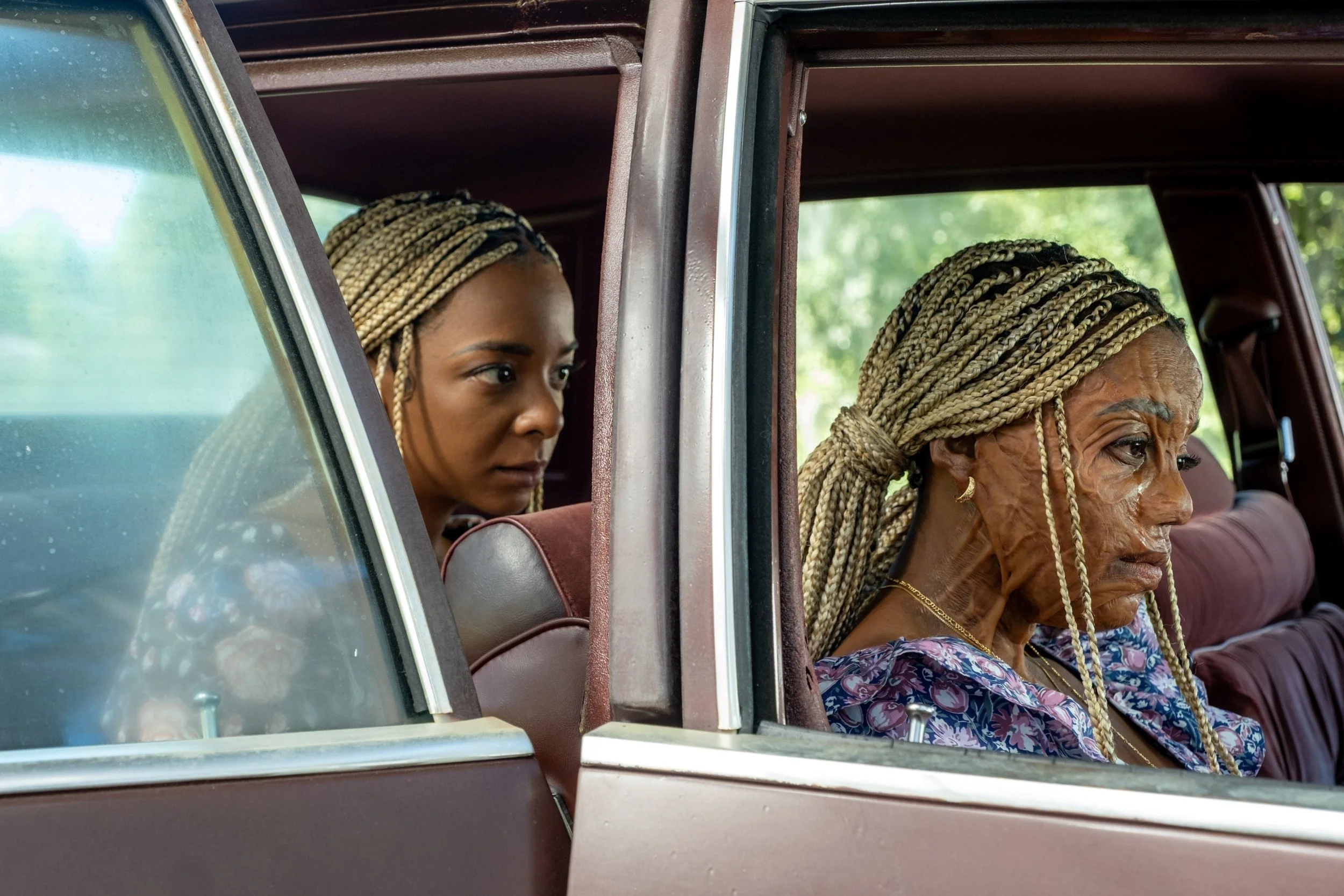
Is God Is is a southern gothic myth about two twin sisters, Racine and Anaia, who are ostensibly two halves of the same being, a duality set piece. They go on an odyssey to avenge their God, who is their mother, against their devil, their father. God has ordered the killing of their father in an arbitrary, distant way of the Christian revenge God, calling upon the Twins, who did not know she existed until the moment they received her letter, demanding ultimate sacrifice from them. They employ the biblical sling and the rock as they embody avenging angels.
On their hero’s journey, Racine and Anaia encounter various cult-leader minitours and masochist-kink cyclops archetypes that are nothing more than that: devices to move them along the way. The odyssey ultimately lands the twins at a Shangri-La in the imaginary southern desert, the Devil’s home for his new family, which includes another set of boy twins: Scotch and Riley. There are action sequences, clumsy horror, and confrontations thereafter. Revenge is delivered, but at a price.
One can search other plot reviews to get the ins and outs of the story. I wanted to write about opportunities lost here, even amongst crisp iconography and distinct moments of assured filmmaking.
This film is full of icons of myth, full of exciting modern pictures of a new Black southern mythos, but it fails to indulge them in a way that would be meaningful. To introduce a Black southern myth aesthetic and not linger in that presence is such a missed opportunity. The audience loses all the beautiful and painful sense of place as weirdly and easily as Cine and Naia lose their hooptie in the second act. The film is full of tantalizing glimpses and morsels of deep, resonate being that it abandons for cheap horror schlock. Icons that do not pay off. Why the color TV cartoon in the sepia memory to match the color of the blood?
Imagine the scene without the flashback even, and just the words of God the mother speaking of deep and unimaginable trauma, speaking to her estranged and damaged twins, allowing the faces and the space they occupy, to deliver it. Missed opportunities about Racine and Ania, arrive everywhere. When Racine says, “we was always gone get fired,” after they lose their working-class job for defending their humanity, we lose all those opportunities to silly, sensational things, to fits and starts. We cannot help feel the loss everywhere throughout the film. Racine said, “God is finna die,” and oh how the mind reels with the possibilities in that line alone.
The thing with comic-booking Black trauma is it becomes sensation, spectacle, a child playing with toys. Revenge becomes The Avengers.
Black trauma makes for extraordinary expressionistic art, no doubt, and fuels a whole American pop culture. When it is masterfully explored, there is nothing more compelling, more alluring, more prescient, nothing more touching. Once you have experienced that rich, deep soil contextualized through art in a masterful way, you can only think of the opportunities available to any and every Black artist.

D.A. Bullock is an award-winning filmmaker, writer, radio host and story-based organizer in Minneapolis. His films have been featured at national and international festivals including Toronto International Film Festival and Chicago International Film Festival. He is host of No Name in The Street; a politics, music, roots & culture show on KFAI 90.3 FM in the Twin Cities.